A Short Story
Leo Tolstoy
In a certain town there lived a cobbler, Martin Avdéitch by name. He had a tiny room in a basement, the one window of which looked out on to the street. Through it one could only see the feet of those who passed by, but Martin recognized the people by their boots. He had lived long in the place and had many acquaintances. There was hardly a pair of boots in the neighborhood that had not been once or twice through his hands, so he often saw his own handiwork through the window. Some he had re-soled, some patched, some stitched up, and to some he had even put fresh uppers. He had plenty to do, for he worked well, used good material, did not charge too much, and could be relied on. If he could do a job by the day required, he undertook it; if not, he told the truth and gave no false promises; so he was well known and never short of work.
Martin had always been a good man; but in his old age he began to think more about his soul and to draw nearer to God. While he still worked for a master, before he set up on his own account, his wife had died, leaving him with a three-year old son. None of his elder children had lived, they had all died in infancy. At first Martin thought of sending his little son to his sister's in the country, but then he felt sorry to part with the boy, thinking: "It would be hard for my little Kapitón to have to grow up in a strange family; I will keep him with me."
Martin left his master and went into lodgings with his little son. But he had no luck with his children. No sooner had the boy reached an age when he could help his father and be a support as well as a joy to him, than he fell ill and, after being laid up for a week with a burning fever, died. Martin buried his son, and gave way to despair so great and overwhelming that he murmured against God. In his sorrow he prayed again and again that he too might die, reproaching God for having taken the son he loved, his only son while he, old as he was, remained alive. After that Martin left off going to church.
One day an old man from Martin's native village who had been a pilgrim for the last eight years, called in on his way from Tróitsa Monastery. Martin opened his heart to him, and told him of his sorrow.
"I no longer even wish to live, holy man," he said. "All I ask of God is that I soon may die. I am now quite without hope in the world."
The old man replied: "You have no right to say such things, Martin. We cannot judge God's ways. Not our reasoning, but God's will, decides. If God willed that your son should die and you should live, it must be best so. As to your despair ? that comes because you wish to live for your own happiness."
"What else should one live for?" asked Martin.
"For God, Martin," said the old man. "He gives you life, and you must live for Him. When you have learnt to live for Him, you will grieve no more, and all will seem easy to you."
Martin was silent awhile, and then asked: "But how is one to live for God?"
The old man answered: "How one may live for God has been shown us by Christ. Can you read? Then buy the Gospels, and read them: there you will see how God would have you live. You have it all there."
These words sank deep into Martin's heart, and that same day he went and bought himself a Testament in large print, and began to read.
At first he meant only to read on holidays, but having once begun he found it made his heart so light that he read every day. Sometimes he was so absorbed in his reading that the oil in his lamp burnt out before he could tear himself away from the book. He continued to read every night, and the more he read the more clearly he understood what God required of him, and how he might live for God. And his heart grew lighter and lighter. Before, when he went to bed he used to lie with a heavy heart, moaning as he thought of his little Kapitón; but now he only repeated again and again: "Glory to Thee, glory to Thee, O Lord! Thy will be done!"
From that time Martin's whole life changed. Formerly, on holidays he used to go and have tea at the public house, and did not even refuse a glass or two of vódka. Sometimes, after having had a drop with a friend, he left the public house not drunk, but rather merry, and would say foolish things: shout at a man, or abuse him. Now, all that sort of thing passed away from him. His life became peaceful and joyful. He sat down to his work in the morning, and when he had finished his day's work he took the lamp down from the wall, stood it on the table, fetched his book from the she lf, opened it, and sat down to read. The more he read the better he understood, and the clearer and happier he felt in his mind.
It happened once that Martin sat up late, absorbed in his book. He was reading Luke's Gospel; and in the sixth chapter he came upon the verses:
"To him that smiteth thee on the one cheek offer also the other; and from him that taketh away thy cloak withhold not thy coat also. Give to every man that asketh thee; and of him that taketh away thy goods ask them not again. And as ye would that men should do to you, do ye also to them likewise."
He also read the verses where our Lord says:
"And why call ye me, Lord, Lord, and do not the things which I say? Whosoever cometh to me, and heareth my sayings, and doeth them, I will shew you to whom he is like: He is like a man which built an house, and digged deep, and laid the foundation on a rock: and when the flood arose, the stream beat vehemently upon that house, and could not shake it: for it was founded upon a rock. But he that heareth and doeth not, is like a man that without a foundation built an house upon the earth, against which the stream did beat vehemently, and immediately it fell; and the ruin of that house was great."
When Martin read these words his soul was glad within him. He took off his spectacles and laid them on the book, and leaning his elbows on the table pondered over what he had read. He tried his own life by the standard of those words, asking himself:
"Is my house built on the rock, or on sand? If it stands on the rock, it is well. It seems easy enough while one sits here alone, and one thinks one has done all that God commands; but as soon as I cease to be on my guard, I sin again. Still I will persevere. It brings such joy. Help me, O Lord!"
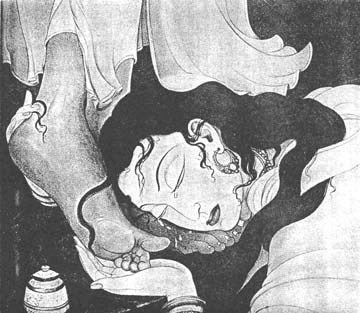
He thought all this, and was about to go to bed, but was loth to leave his book. So he went on reading the seventh chapter about the centurion, the widow's son, and the answer to John's disciples and he came to the part where a rich Pharisee invited the Lord to his house; and he read how the woman who was a sinner, anointed his feet and washed them with her tears, and how he justified her. Comin g to the forty-fourth verse, he read:
"And turning to the woman, he said unto Simon, Seest thou this woman? I entered into thine house, thou gavest me no water for my feet: but she hath wetted my feet with her tears, and wiped them with her hair. Thou gavest me no kiss; but she, since the time I came in, hath not ceased to kiss my feet. My head with oil thou didst not anoint: but she hath anointed my feet with ointment."
He read these verses and thought: "He gave no water for his feet, gave no kiss, his head with oil he did not anoint?" And Martin took off his spectacles once more, laid them on his book, and pondered.
"He must have been like me, that Pharisee. He too thought only of himself how to get a cup of tea, how to keep warm and comfortable; never a thought of his guest. He took care of himself, but for his guest he cared nothing at all. Yet who was the guest? The Lord himself! If he came to me, should I behave like that?"
Then Martin laid his head upon both his arms and, before he was aware of it, he fell asleep.
"Martin!" he suddenly heard a voice, as if some one had breathed the word above his ear.
He started from his sleep. "Who's there?" he asked.
He turned round and looked at the door; no one was there. He called again. Then he heard quite distinctly: "Martin, Martin! Look out into the street tomorrow, for I shall come."
Martin roused himself, rose from his chair and rubbed his eyes, but did not know whether he had heard these words in a dream or awake. He put out the lamp and lay down to sleep.
Next morning he rose before daylight, and after saying his prayers he lit the fire and prepared his cabbage soup and buckwheat porridge. Then he lit the samovár, put on his apron, and sat down by the window to his work. As he sat working Martin thought over what had happened the night before. At times it seemed to him like a dream, and at times he thought that he had really heard the voice. "Such things have happened before now," thought he.
So he sat by the window, looking out into the street more than he worked, and whenever any one passed in unfamiliar boots he would stoop and look up, so as to see not the feet only but the face of the passer-by as well. A house-porter passed in new felt boots; then a water-carrier. Presently an old soldier of Nicholas' reign came near the window, spade in hand. Martin knew him by his boots, which were shabby old felt ones, galoshed with leather. The old man was called Stepánitch: a neighboring tradesman kept him in his house for charity, and his duty was to help the house-porter. He began to clear away the snow before Martin's window. Martin glanced at him and then went on with his work.
"I must be growing crazy with age," said Martin, laughing at his fancy. "Stepánitch comes to clear away the snow, and I must needs imagine it's Christ coming to visit me. Old dotard that I am!"
Yet after he had made a dozen stitches he felt drawn to look out of the window again. He saw that Stepánitch had leaned his spade against the wall, and was either resting himself or trying to get warm. The man was old and broken down, and had evidently not enough strength even to clear away the snow.
"What if I called him in and gave him some tea?" thought Martin. "The samovár is just on the boil."
He stuck his awl in its place, and rose; and putting the samovár on the table, made tea. Then he tapped the window with his fingers. Stepánitch turned and came to the window. Martin beckoned to him to come in, and went himself to open the door.
"Come in,"  he said, "and warm yourself a bit. I'm sure you must be cold."
"May God bless you!" Stepánitch answered. "My bones do ache to be sure." He came in, first shaking off the snow, and lest he should leave marks on the floor he began wiping his feet; but as he did so he tottered and nearly fell.
"Don't trouble to wipe your feet," said Martin "I'll wipe up the floor it's all in the day's work. Come, friend, sit down and have some tea."
Filling two tumblers, he passed one to his visitor, and pouring his own out into the saucer, began to blow on it.
Stepánitch emptied his glass, and, turning it upside down, put the remains of his piece of sugar on the top. He began to express his thanks, but it was plain that he would be glad of some more.
"Have another glass," said Martin, refilling the visitor's tumbler and his own. But while he drank his tea Martin kept looking out into the street.
"Are you expecting any one?" asked the visitor.
"Am I expecting any one? Well, now, I'm ashamed to tell you. It isn't that I really expect any one; but I heard something last night which I can't get out of my mind. Whether it was a vision, or only a fancy, I can't tell. You see, friend, last night I was reading the Gospel, about Christ the Lord, how he suffered, and how he walked on earth. You have heard tell of it, I dare say."
"I have heard tell of it," answered Stepánitch; "but I'm an ignorant man and not able to read."
"Well, you see, I was reading of how he walked on earth. I came to that part, you know, where he went to a Pharisee who did not receive him well. Well, friend, as I read about it, I thought now that man did not receive Christ the Lord with proper honor. Suppose such a thing could happen to such a man as myself, I thought, what would I not do to receive him! But that man gave him no reception at all. Well, friend, as I was thinking of this, I began to doze, and as I dozed I heard some one call me by name. I got up, and thought I heard someone whispering, 'Expect me; I will come to-morrow.' This happened twice over. And to tell you the truth, it sank so into my mind that, though I am ashamed of it myself, I keep on expecting him, the dear Lord!"
Stepánitch shook his head in silence, finished his tumbler and laid it on its side; but Martin stood it up again and refilled it for him.
"Here drink another glass, bless you! And I was thinking too, how he walked on earth and despised no one, but went mostly among common folk. He went with plain people, and chose his disciples from among the likes of us, from workmen like us, sinners that we are. 'He who raises himself,' he said, 'shall be humbled and he who humbles himself shall be raised.' 'You call me Lord,' he said, 'and I will wash your feet.' 'He who would be first,' he said, 'let him be the servant of all; because,' he said, 'blessed are the poor, the humble, the meek, and the merciful.'"
Stepánitch forgot his tea. He was an old man easily moved to tears, and as he sat and listened the tears ran down his cheeks.
"Come, drink some more," said Martin. But Stepánitch crossed himself, thanked him, moved away his tumbler, and rose.
"Thank you, Martin Avdéitch," he said, "you have given me food and comfort both for soul and body."
"You're very welcome. Come again another time. I am glad to have a guest," said Martin.
Stepánitch went away; and Martin poured out the last of the tea and drank it up. Then he put away the tea things and sat down to his work, stitching the back seam of a boot. And as he stitched he kept looking out of the window, waiting for Christ, and thinking about him and his doings. And his head was full of Christ's sayings.
Two soldiers went by: one in government boots, and the other in boots of his own; then the master of a neighboring house, in shining galoshes; then a baker carrying a basket. All these passed on. Then a woman came up in worsted stockings and peasant-made shoes. She passed the window, but stopped  by the wall. Martin glanced up at her through the window, and saw that she was a stranger, poorly dressed, and with a baby in her arms. She stopped by the wall with her back to the wind, trying to wrap the baby up, though she had hardly anything to wrap it in. The woman had only summer clothes on, and even they were shabby and worn. Through the window Martin heard the baby crying, and the woman trying to soothe it, but unable to do so. Martin rose and going out of the door and up the steps he called to her.
"My dear, I say, my dear!"
The woman heard, and turned round.
"Why do you stand out there with the baby in the cold? Come inside. You can wrap him up better in a warm place. Come this way!"
The woman was surprised to see an old man in an apron, with spectacles on his nose, calling to her, but she followed him in.
They went down the steps, entered the little room, and the old man led her to the bed.
"There, sit down, my dear, near the stove. Warm yourself, and feed the baby."
"Oh, I haven't got any milk. I have eaten nothing myself since early morning," said the woman, but still she took the baby to her breast.
Martin sho ok his head. He brought out a basin and some bread. Then he opened the oven door and poured some cabbage soup into the basin. He took out the porridge pot also but the porridge was not yet ready, so he spread a cloth on the table and served only the soup and bread.
"Sit down and eat, my dear, and I'll mind the baby. Why, bless me, I've had children of my own; I know how to manage them."
The woman crossed herself, and sitting down at the table began to eat, while Martin put the baby on the bed and sat down by it. He chucked and chucked, but having no teeth he could not do it well and the baby continued to cry. Then Martin tried poking at him with his finger; he drove his finger straight at the baby's mouth and then quickly drew it back, and did this again and again. He did not let the baby take his finger in its mouth, because it was all black with cobbler's wax. But the baby first grew quiet watching the finger, and then began to laugh. And Martin felt quite pleased.
The woman sat eating and talking, and told him who she was, and where she had been.
"I'm a soldier's wife," said she. "They sent my husband somewhere, far away, eight months ago, and I have heard nothing of him since. I had a place as cook till my baby was born, but then they would not keep me with a child. For three months now I have been struggling, unable to find a place, and I've had to sell all I had for food. I tried to go as a wet-nurse, but no one would have me; they said I was too starved-looking and thin. Now I have just been to see a tradesman's wife (a woman from our village is in service with her) and she has promised to take me. I thought it was all settled at last, but she tells me not to come till next week. It is far to her place, and I am fagged out, and baby is quite starved, poor mite. Fortunately our landlady has pity on us, and lets us lodge free, else I don't know what we should do."
Martin sighed. "Haven't you any warmer clothing?" he asked.
"How could I get warm clothing?" said she. "Why I pawned my last shawl for sixpence yesterday."
Then the woman came and took the child, and Martin got up. He went and looked among some things that were hanging on the wall, and brought back an old cloak.
"Here," he said, "though it's a worn-out old thing, it will do to wrap him up in."
The woman looked at the cloak, then at the old man, and taking it, burst into tears. Martin turned away, and groping under the bed brought out a small trunk. He fumbled about in it, and again sat down opposite the woman. And the woman said:
"The Lord bless you, friend. Surely Christ must have sent me to your window, else the child would have frozen. It was mild when I started, but now see how cold it has turned. Surely it must have been Christ who made you look out of your window and take pity on me, poor wretch!"
Martin smiled and said, "It is quite true; it was he made me do it. It was no mere chance made me look out."
And he told the woman his dream, and how he had heard the Lord's voice promising to visit him that day.
"Who knows? All things are possible," said the woman. And she got up and threw the cloak over her shoulders, wrapping it round herself and round the baby. Then she bowed, and thanked Martin once more.
"Take this for Christ's sake," said Martin, and gave her sixpence to get her shawl out of pawn. The woman crossed herself, and Martin did the same, and then he saw her out.
After the woman had gone, Martin ate some cabbage soup, cleared the things away, and sat down to work again. He sat and worked, but did not forget the window, and every time a shadow fell on it he looked up at once to see who was passing. People he knew and strangers passed by, but no one remarkable.
After a while Martin saw an apple-woman stop just in front of his window. She had a large basket, but there did not seem to be many apples left in it; she had evidently sold most of her stock. On her back she had a sack full of wood chips, which she was taking home. No doubt she had gathered them at some place where building was going on. The sack evidently hurt her, and she wanted to shift it from one shoulder to the other, so she put it down on the foot path and, placing her basket on a post, began to shake down the chips in the sack. While she was doing this a boy in a tattered cap ran up, snatched an apple out of the basket, and tried to slip away; but the old woman noticed it, and turning, caught the boy by his sleeve. He began to struggle, trying to free himself, but the old woman held on with both hands, knocked his cap off his head, and seized hold of his hair. The boy squawked and the old woman scolded him. Martin dropped his awl, not waiting to stick it in its place, and rushed out of the door. Stumbling up the steps, and dropping his spectacles in his hurry, he ran out into the street. The old woman was pulling the boy's hair and scolding him, and threatening to take him to the police. The lad was struggling and protesting, saying, "I did not take it. What are you beating me for? Let me go!"
Martin separated them. He took the boy by the hand and said, "Let him go, Granny. Forgive him for Christ's sake."
"I'll pay him out, so that he won't forget it for a year! I'll take the rascal to the police!"
Martin began entreating the old woman.
"Let him go, Granny. He won't do it again. Let him go for Christ's sake!"
The old woman let go, and the boy wished to run away, but Martin stopped him.
"Ask the Granny's forgiveness!" said he. "And don't do it another time. I saw you take the apple."
The boy began to cry and to beg pardon.
"That's right. And now here's an apple for you," and Martin took an apple from the basket and gave it to the boy, saying, "I will pay you, Granny."
"You will spoil them that way, the young rascals," said the old woman. "He ought to be whipped so that he should remember it for a week."
"Oh, Granny, Granny," said Martin, "that's our way ? but it's not God's way. If he should be whipped for stealing an apple, what should be done to us for our sins?"
The old woman was silent.
And Martin told her the parable of the lord who forgave his servant a large debt, and how the servant went out and seized his debtor by the throat. The old woman listened to it all, and the boy, too, stood by and listened.
"God bids us forgive," said Martin, "or else we shall not be forgiven. Forgive every one; and a thoughtless youngster most of all."
The old woman wagged her head and sighed.
"It's true enough," said she, "but they are getting terribly spoilt."
"Then we old ones must show them better ways," Martin replied.
"That's just what I say," said the old woman. "I have had seven of them myself, and only one daughter is left." And the old woman began to tell how and where she was living with her daughter, and how many grandchildren she had. "There now," she said, "I have but little strength left, yet I work hard for the sake of my grandchildren; and nice children they are, too. No one comes out to meet me but the children. Little Annie, now, won't leave me for any one. ?It's grandmother, dear grandmother, darling grandmother.'" And the old woman completely softened at the thought.
"Of course, it was only his childishness, God help him," said she, referring to the boy.
As the old woman was about to hoist her sack on her back, the lad sprang forward to her, saying, "Let me carry it for you, Granny. I'm going that way."
The old woman nodded her head, and put the sack on the boy's back, and they went down the street together, the old woman quite forgetting to ask Martin to pay for the apple. Martin stood and watched them as they went along talking to each other.
When they were out of sight Martin went back to the house. Having found his spectacles unbroken on the steps, he picked up his awl and sat down again to work. He worked a little, but could soon not see to pass the bristle through the holes in the leather; and presently he noticed the lamplighter passing on his way to light the street lamps.
"Seems it's time to light up," thought he. So he trimmed his lamp, hung it up, and sat down  again to work. He finished off one boot and, turning it about, examined it. It was all right. Then he gathered his tools together, swept up the cuttings, put away the bristles and the thread and the awls, and, taking down the lamp, placed it on the table. Then he took the Gospels from the shelf. He meant to open them at the place he had marked the day before with a bit of morocco, but the book opened at another place. As Martin opened it, his yesterday's dream came back to his mind, and no sooner had he thought of it than he seemed to hear footsteps, as though some one were moving behind him. Martin turned round, and it seemed to him as if people were standing in the dark corner, but he could not make out who they were. And a voice whispered in his ear: "Martin, Martin, don't you know me?"
"Who is it?" muttered Martin.
"It is I," said the voice. And out of the dark corner stepped Stepánitch, who smiled and vanishing like a cloud was seen no more.
"It is I," said the voice again. And out of the darkness stepped the woman with the baby in her arms and the woman smiled and the baby laughed, and they too vanished.
"It is I," said the voice once more. And the old woman and the boy with the apple stepped out and both smiled, and then they too vanished.
And Martin's soul grew glad. He crossed himself put on his spectacles, and began reading the Gospel just where it had opened; and at the top of the page he read
"I was a hungered, and ye gave me meat: I was thirsty, and ye gave me drink: I was a stranger, and ye took me in."
And at the bottom of the page he read:
"Inasmuch as ye did it unto one of these my brethren even these least, ye did it unto me." And Martin understood that his dream had come true; and that the Savior had really come to him that day, and he had welcomed him.
This story was written in 1885. This English translation is reprinted from Leo Tolstoy, Walk in the Light and Twenty-Three Tales (Plough, 1999). Used by permission . Available as a free e-book, visit www.bruderhof.com


 But unless you’re an experienced designer, I don’t recommend laying the cover out yourself. The whole concept behind Wordclay is DIY publishing through being affordable.