Penumbral Eclipse Begins: 05:29:17 UT Partial Eclipse Begins: 06:32:37 UT Total Eclipse Begins: 07:40:47 UT Greatest Eclipse: 08:16:57 UT Total Eclipse Ends: 08:53:08 UT Partial Eclipse Ends: 10:01:20 UT Penumbral Eclipse Ends: 11:04:31 UT
Saturday, December 18, 2010
Lunar Eclipse - December 21, 2010
Friday, July 16, 2010
Insect Eating Clock? I Kid You Not!
This is some cool thinking outside the box! Talk about using the concept of a non-toxic fuel cell that is also self sustaining!
You'll never look at a clock the same way again . . . . because you will remember this new time-piece.
This prototype clock traps insects on flypaper stretched across its roller system before depositing them into a vat of bacteria. The ensuing chemical reaction, or "digestion," is transformed into power that keeps the rollers rollin' and the LCD clock ablaze.
The inventors also offer an alternative design fueled by mice, another contraption whose robotic arm plucks insect-fuel from spider webs with the help of a video camera, and a lamp powered by insects lured to their deaths with ultraviolet LEDs.
Man, this is so wrong it has to be right . . . . or, at least on the right track
SOURCING:
Designers -- UK-based James Auger and Jimmy Loizeau
Engadget
Wednesday, November 25, 2009
Thursday, November 12, 2009
Atoms Around Us
http://www.chem4kids.com/files/atom_intro.html
If you want to have a language, you will need an alphabet. If you want to build proteins, you will need amino acids. Other examples in chemistry are not any different. If you want to build molecules, you will need elements. Each element is a little bit different from the rest. Those elements are the alphabet to the language of molecules.Why are we talking about elements? This is the section on atoms.
Confused? Don't be. Elements are like those letters. They have something in common. That's where atoms come in. All elements are made of atoms. While the atoms may have different weights and organization, they are all built in the same way. Electrons, protons, and neutrons make the universe go.
If you want to do a little more thinking, start with particles of matter. Matter, the stuff around us, is used to create atoms. Atoms are used to create the elements. Elements are used to create molecules. It just goes on. Everything you see is built by using something else.
You could start really small...
- Particles of matter
- Atoms
- Elements
- Molecules
- Macromolecules
- Cell organelles
- Cells
- Tissues
- Organs
- Systems
- Organisms
- Populations
- Ecosystems
- Biospheres
- Planets
- Planetary Systems with Stars
- Galaxies
- The Universe
.And finish really big.
Wow. All of that is possible because of atoms.
Monday, November 02, 2009
What's the Matter?
Matter is the Stuff Around You
You should know about solids, liquids, gases, plasmas, and a new one called Bose-Einstein condensates. The first four have been around a long time. The scientists who worked with the Bose-Einstein condensate received a Nobel Prize for their work in 1995. But what makes a state of matter? It's about the physical state of molecules and atoms.
Changing States of Matter
So you ask, "What is a chemical state?" If the formula of water were to change, that would be a chemical change. If you added another oxygen atom, you would make hydrogen peroxide (H2O2). Its molecules would not be water anymore. Changing states of matter is about changing densities, pressures, temperatures, and other physical properties. The basic chemical structure does not change.
Thursday, October 22, 2009
Jello Animal Cell
The following is a glossary of animal cell terms: cell membrane - the thin layer of protein and fat that surrounds the cell. The cell membrane is semipermeable, allowing some substances to pass into the cell and blocking others.
centrosome - (also called the "microtubule organizing center") a small body located near the nucleus - it has a dense center and radiating tubules. The centrosomes is where microtubules are made. During cell division (mitosis), the centrosome divides and the two parts move to opposite sides of the dividing cell. The centriole is the dense center of the centrosome.
cytoplasm - the jellylike material outside the cell nucleus in which the organelles are located.
Golgi body - (also called the Golgi apparatus or golgi complex) a flattened, layered, sac-like organelle that looks like a stack of pancakes and is located near the nucleus. It produces the membranes that surround the lysosomes. The Golgi body packages proteins and carbohydrates into membrane-bound vesicles for "export" from the cell.
lysosome - (also called cell vesicles) round organelles surrounded by a membrane and containing digestive enzymes. This is where the digestion of cell nutrients takes place.
mitochondrion - spherical to rod-shaped organelles with a double membrane. The inner membrane is infolded many times, forming a series of projections (called cristae). The mitochondrion converts the energy stored in glucose into ATP (adenosine triphosphate) for the cell.
nuclear membrane - the membrane that surrounds the nucleus.
nucleolus - an organelle within the nucleus - it is where ribosomal RNA is produced. Some cells have more than one nucleolus.
nucleus - spherical body containing many organelles, including the nucleolus. The nucleus controls many of the functions of the cell (by controlling protein synthesis) and contains DNA (in chromosomes). The nucleus is surrounded by the nuclear membrane.
ribosome - small organelles composed of RNA-rich cytoplasmic granules that are sites of protein synthesis.
rough endoplasmic reticulum - (rough ER) a vast system of interconnected, membranous, infolded and convoluted sacks that are located in the cell's cytoplasm (the ER is continuous with the outer nuclear membrane). Rough ER is covered with ribosomes that give it a rough appearance. Rough ER transports materials through the cell and produces proteins in sacks called cisternae (which are sent to the Golgi body, or inserted into the cell membrane).
smooth endoplasmic reticulum - (smooth ER) a vast system of interconnected, membranous, infolded and convoluted tubes that are located in the cell's cytoplasm (the ER is continuous with the outer nuclear membrane). The space within the ER is called the ER lumen. Smooth ER transports materials through the cell. It contains enzymes and produces and digests lipids (fats) and membrane proteins; smooth ER buds off from rough ER, moving the newly-made proteins and lipids to the Golgi body, lysosomes, and membranes.
vacuole - fluid-filled, membrane-surrounded cavities inside a cell. The vacuole fills with food being digested and waste material that is on its way out of the cell.
Source: http://www.enchantedlearning.com/subjects/animals/cell/
More good stuff!
Plant Cell PrintoutBacterium Cell Printout
Animal Cell
Label Me! Printout
Tuesday, October 20, 2009
Whales
Blue whales are rorqual whales, whales that have pleated throat grooves that allow their throat to expand during the huge intake of water during filter feeding. Blue whales have 50-70 throat grooves that run from the throat to mid-body. Here is a picture os a blue whale.
Links for more info:
- the Sperm whale (a Toothed Whale)
- the Beluga whale (a Toothed Whale)
- the Blue whale (a Rorqual Whale)
- the Right Whale (a Baleen Whale)
Thursday, April 17, 2008
Monday, April 14, 2008
Ocean Information Hunt
1) Oceans cover more than _______ % of the earth's surface.
3) What are the 5 largest oceans?
4) Which is the largest ocean?
5) What was the H.M.S. Challenger?
6) What are hydrothermal vents?
7) Give 5 examples of sources of ocean pollution.
8) Where did the Exxon Valdez oil spill take place?
9) What year did the oil spill happen?
for elementary sctudents -- 2nd through 4th
http://www.calstatela.edu/faculty/eviau/edit557/oceans/linda/loceans.htm
Thursday, April 03, 2008
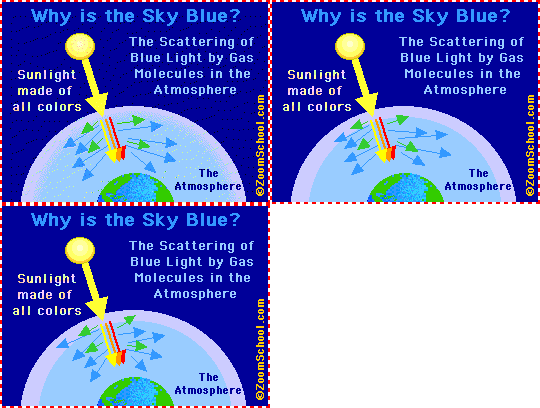
Why is the Sky Blue?
The gas molecules in the atmosphere scatter the higher-energy (high frequency) blue portion of the sunlight more than they scatter the lower-energy red portion of the sunlight (this is called Rayleigh scattering, named for the physicist Lord John Rayleigh). The Sun appears reddish-yellow and the sky surrounding the Sun is colored by the scattered blue waves.
When the Sun is lower in the horizon (near sunrise or sunset), the sunlight must travel through a greater thickness of atmosphere than it does when it is overhead, and even more light is scattered (not just blue, but also green, yellow, and orange) before the light reaches your eyes. This makes the sun look much redder.
Caution: Never stare directly at the Sun.
Extra Credit Question for everyone: What do the letters of this acronym stand for?
Roy G. Biv
Questions for middle school students:
1) How many miles away from the earth is the sun?
2) How long does it take the sun's light to reach the earth?
3) The continuous fusion of WHAT? into WHAT? keeps the core of the Sun cooking at HOW MANY DEGREES? degrees Fahrenheit.
4) How long would it take traveling nonstop at 70mph to reach the sun?
Look here for answers to #s 1 through 4.
5) What bends more - violet light or red light? You can find the answer here. The author of this answer is Lou Bloomfield, Professor of Physics, University of Virginia.
6) Does light refract? Why or why not?
Refract: The turning or bending of any wave when it passes from one medium into another of different density. (source: Answers.com)
sources:
Enchanted Learning
Answers.com
windows.ucar.edu.com
Howthingswork.virginia.edu